|
|
|
|
 |
|
 |
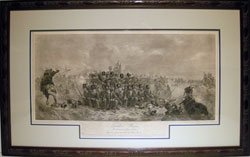
Duke of Wellington
showing the field of battle of his greatest victory over the
French to the young Queen Victoria!

A DIALOGUE AT WATERLOO
"The most infamous army I ever commanded..."
-The Iron Duke on his troops at Waterloo.
Engraved By T.H. Atkinson after Sir Edwin Landseer.
London Ca.1851
A fine copper engraving depicting the old Duke of Wellington showing
the field of battle of his greatest victory over the French to
the young Queen Victoria, On that occasion views of the battle
were presented during an informal picnic.
Five exquisitely drawn and engraved horses are also portrayed.
The bronze monumental lion may be seen atop the mound in the rear,
raised by the Dutch between 1823 and 1826 on the spot where it
is believed the Prince of Orange was wounded. The mound required
290,485 cubic meters of earth from the surrounding fields to attain
a height of 40.5 meters Note the fine detail as illustrated in
this photograph which concentrates on the young ladies book.
The original painting, finished in 1850, presently hangs in the
Speaker's Guest Room within the British House of Lords, London.

Sir Edwin Henry Landseer RA. RI. (1802-1873)
was without doubt one of the finest animal painters England has
ever produced. He was born in London, the son of John Landseer
ARA. He first exhibited works at the Royal Academy in 1815, at
the precocious age of 13. He was elected ARA at the age of 24,
and RA some five years later in 1831. Further honours followed
- he was knighted in 1850, received a gold medal at the Paris
Exhibition of 1855, and in 1866 was elected President of the
Royal Academy, a position which he declined to accept.
|
 |
|
 |
|
|
|
|
|
|
|
|
“... THE MOST INFAMOUS ARMY I EVER COMMANDED “
Wellington (on the composition of his army at Waterloo)
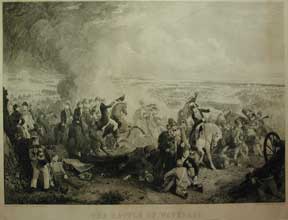
THE BATTLE OF WATERLOO
[Wellington at the scene]
Engraved by John Burnet after the painting by J.A. Atkinson, portraits by A.W. Devis
RARE. Copper engraving [London] 1819
161/2 x 231/4” excluding letters (42 x 59 cm)
Depicted is a general scene toward the end of the battle on 18 June 1815, with Wellington in attendance, from the British vantage, Portraits of the main allied participants are identifiable, including that of the 'Iorn' Duke Wellington; who, despite his generally poor opinion of his troops (quoted above) is shown saluting the capture of a French Eagle standard by Sergeant Ewart of the Scots Greys. Napoleon’s Garde Impériale are shown in disorderly retreat signifining the moment of Allied victory.
This image was considered scarce even in 1819, as contrary to the original intention of the engraver, there were never very many copies of this image published, making it highly desirable for today’s collector of military and particularly Waterloo images.
Waterloo produced many iconic myths and also courageous heroes, not least among them the actions of many members of the cavalry. It seems unlikely that the Duke of Wellington said that Waterloo was won on the playing fields of Eton, not least because Eton had no playing fields, in the modern sense at that time. But he undoubtedly did say : “It was a damned nice thing [‘nice’ meaning close and all too finely balanced], the nearest thing you ever saw in your life.” Warner , P. The British Cavalry. p.116 .
Little wonder then, that this battle was regarded as one of the most significant in British history, much as ‘The Battle of Britain’ was to be over a hundred years later.
John Burnet 1784-1868 became a Scottish painter, etcher and engraver of historical subjects, after his contemporaries and old masters. Born in Midlothian, he lived in Edinburgh. He was one of the first engravers to specialize in the reproduction of paintings for the new middle class collector, and he pioneered the use of steel plates, although this image is engraved into copper and was not widely circulated. He died in Stoke-Newington.
John Augustus Atkinson 1775 - 1831/3? was a painter, etcher and aquatint engraver of historical subjects. In 1784 he accompanied his uncle to Russia in the service of the Empress Catherine.
Arthur William Devis 1762 - 1822 Following the shipwreck in ca. 1783 of the Antelope, aboard which he was listed as draughtsman, Devis travelled on to Bengal, India were he became a society painter of portraits. Upon his return to England he exhibited some 65 pictures at the Royal Academy between 1779 - 1821.
Click for more
information on the printing technique. RETURN
TO MILITARY CATALOGUE
|
|
|
|
|
|
|
|
|
 |
|
 |
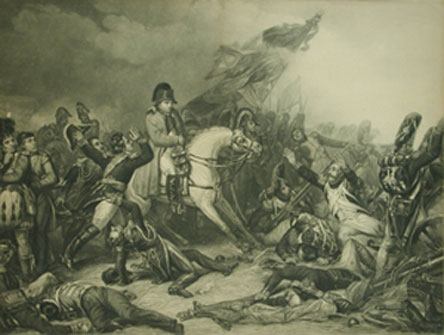
[NAPOLEON] BONAPARTE AT WATERLOO
[Mounted, and in the thick of it ]
RARE. Mezzotint engraved by (Mrs.?)W.H. Simmons after the painting by Charles Steuben, [London 1838] Trimmed to 16 ¾ x 21 ¾ ” (42 .5 x 55.2 cm) excluding letters
Despite the fact that Napoleon was suffering from a painful bout of piles on Sunday 18 June1815 (on such details the course of history may be altered), and spent most of the day 3/4 mile away at Rossomme, this image shows him mounted on his white charger Marengo, supposedly in the thick of the battle. It was only about 7.30 pm. that a last stand was made near La Belle Alliance Inn (just visable, upper left), Marshal Ney is portrayed alongside the Emperor surrounded by members of the Imperial Guard and surprisingly a loan kilted Highlander Highlander being a representation of Marshal Etienne-Jacques-Joseph-Alexandre MacDonald, Duke of Taranto (November 17, 1765 September 7, 1840). Shortly thereafter Napoleon’s army was routed and he departed the field of battle.
Baron Charles Auguste Guillaume de Steuben (1788 - 1856) was a 19th cent. French painter active during the Napoleonic era. He trained with Gustave Courbet.
Mrs. Simmons was the wife of William Henry Simmons (1811 -1882) a noted and very successful engraver, born and died in London, and pupil of Finden, he reproduced pictures by many of the famous artists of his day. He later abandoned line engraving in preference for the more complex mixed media mezzotint and became one of the foremost exponants of that style. Of his wife we can find no information.
|
 |
|
 |
|
|
|
|
|
|
|
|
| |
DESCRIPTION |
 |
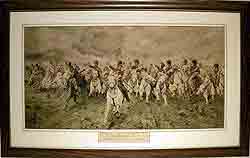
"Scotland Forever!"
[1881 (1885)]
after the original painting by Lady Butler
The charge of the Scots Greys at Waterloo
B/W photogravure, some restoration, [Published] Copyright
by S Hildesheimer Co. Ltd. Manchester; Ca 1885.
13 1/2 x 26"
Ref.LRA1122 /LN/v. annr>LAL SOLD Price code C |
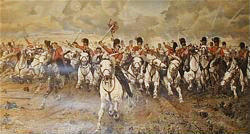 |
Scotland Forever.
The Charge of The Scots Greys at Waterloo
Chromolithograph.
Descriptive text (bottom left).
Published Buffalo Pictorial Co., Buffalo, NY [ca1890]
15 X 27 7/8" excluding letters.
(Ref.DS0570 /DAL/dov>LAL) SOLD Price code C
|
|
SCOTLAND FOREVER.
Elizabeth Thompson, (Lady Butler)
[1881 (1890)]
Chromolithograph. Title in Italics below image, matted, glazed, mahogany gloss lip plastic faux wood frame, glazed. nd. [ca1890]
14 ¾ X 26"approx including letters. Frame 20 ¾ x 30 "
PRICE CODE C
Ref. RY6 (179)/DDN/r.ando>LLN
Although nicely presented, there are alas some condition issues, two repaired tears within image right. They do however make the price of this very collectable image very affordable.
|
RETURN TO MILITARY CATALOGUE
|
|
|
|
|
|
|
|
|
 |
|
 |
What a difference a day makes !
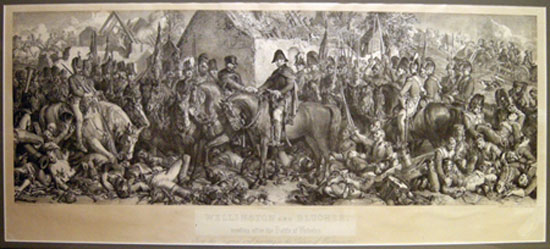
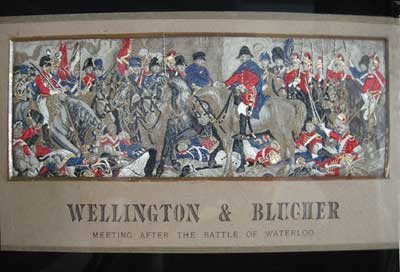
WELLINGTON AND BLUCHER [sic] MEETING AFTER THE BATTLE OF WATERLOO
from the original wall painting in the Palace of Westminster
Lumb Stocks RA. after Daniel Maclise RA.
Transfer Lithograph (from engraving) matted, glazed, black wood frame.
11 7/8 x 34 1/2 (30.2 x 87.7 cm) excluding letters Frame: 19 1/4 x 41 1/4"
Ref. 71NY3/DNN/s.andd >ENN SOLD PRICE CODE B Click here for price guide.
Another Copy
Frame size 21 1/4 x 43 5/8" Ref.RB1(180)/ANN/e.ando>DDNN PAIR PRICE CODE D
together with
'The Death of Nelson at the Battle of Trafalgar'
Published by The Art Union [(1872) 1875], after the 1868 painting. Wellington and Blucher mounted on horses, with cavalry behind them, shake hands in front of ruined building surrounded by numerous mounted and dismounted soldiers and bandsman; dead and wounded lying in the foreground. The French army is seen in pursuit along the road behind. A somewhat fanciful rendering of one of the great melodramatic moments in history.
Late in the evening on the day of the battle of Waterloo (Sunday, June 18th. 1815) Wellington and Blücher met on horseback outside the somewhat battered but aptly named La Belle Alliance inn where they briefly shook hands and congratulated each other on their victory. "Quelle affaire!" the elderly Prussian Marshal exclaimed, - Wellington said afterwards that was all the French he knew. Blücher also suggested La Belle Alliance would be a good name for the battle, but the Duke made no reply.
Following the meeting of the victorious leaders, during the rest of the night the Prussians pursued the remnants of the routed French army, from the inn, down the road toward France by which they had come.
Daniel Maclise, R.A. (1806 -1870) was an Irish historical painter whose fame rests chiefly on a series of lithograph portraits of contemporary celebrities and on two vast frescoes that he painted in the Royal Gallery in the House of Lords. of which this is a copy of one.
|
 |
|
 |
|
|
 |